Monday, March 17, 2014

Divergent: the book, not the movie!


Divergent by Veronica Roth is another one of those book series that is taking young readers by storm. Like the Hunger Games by Suzanne Collins and the Maze Runner by James Dashner, Veronica Roth taps into our current fascination with a post apocalyptic scenarios that seems to leave the fate of the surviving world in the hands of a few courageous teens who seem to have the intelligence, strength and background knowledge to outsmart the evil adult attempts to take over what is left of society.

Beatrice recently turned 16 and has a very important decision to make. Which faction of society should she choose to live? The five factions have been established to divide the population into similar character traits to avoid the global conquest that destroyed their way of life years ago. The Factions have established aptitude tests to help the teens narrow down their choices before the Choosing Ceremony. The aptitude test takes the candidates through a series of moral choices to eliminate factions, and promote strengths in one specific faction.  Unfortunately, Beatrice's results are inconclusive. She is labeled Divergent by her test and warned never to share the results with anyone if she want to avoid a terrible fate.
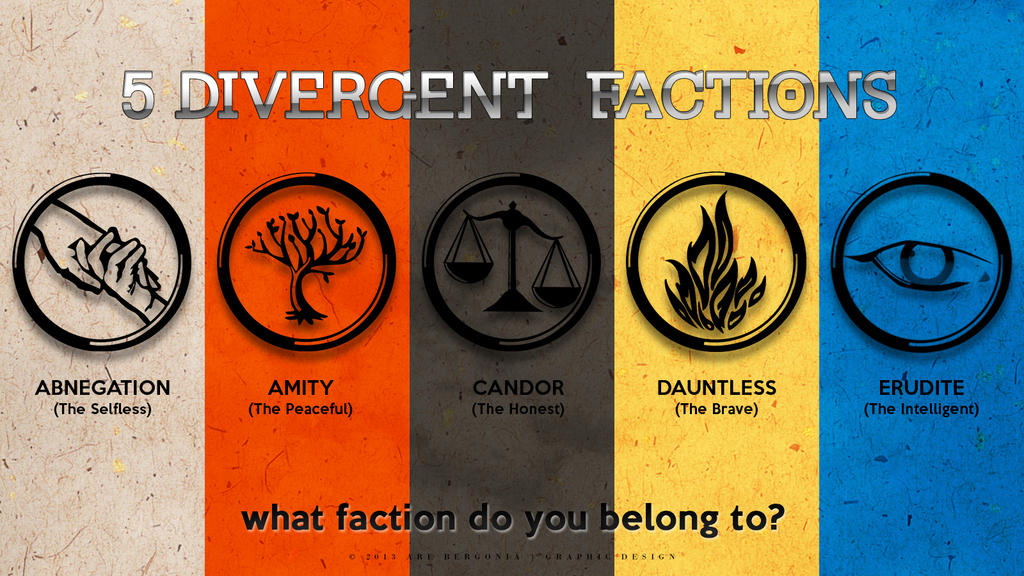
Created by Are Bergonia for DevientART

Of course this warning haunts Beatrice throughout the story as she chooses to leave her family, and join the most reckless faction, Dauntless,  known for their bravery and risk taking. Now called Tris, or Stiff, by her enemies, Beatrice discovers that being Divergent in the faction, given the responsibility for guarding the society from an unknown enemy, has it's advantages, and draws the attention of many different faction leaders.  As the plot thickens to a climatic battle ending, it sets you up nicely for the next book in the series, Insurgent.

I have to warn you that the movie for Divergent comes out March 21.  Watch the movie trailer to get an idea of the type of story you might be getting into.  It's is pretty intense.  Now if you are like me, I recommend reading the book soon, or put off seeing the movie until later so you can finish book one.

My question is, why are these books so appealing?  The plots don't seem to change much from book to book. Are they just becoming a money making machine for mediocre authors taking advantage of a popular trend?  Do these books deserve the accolades they are receiving world wide?

Wednesday, March 5, 2014

The Rise of Narcissism - Is Social Media to Blame?

In recent research for my class's next debate, the topic about the effects of Social Media on our society, and specifically teens, kept coming up in the search.  I have strong opinions about today's social media.  That's not saying I am against it.  I am currently involved in a wide variety of social media sites: Facebook, Twitter, Google+, YouTube, Pinterest, Linked In, and Edmodo. I am also an active participant on various educational blogs, as well at the manager of two blogs I use in my classroom. Of all of these sites, only Facebook is used for personal communication with family or friends.  The information I receive on all of these sites are instantaneous, up-to-date, and productive to my success professionally and personally.  I have had the joy of watching my nieces and nephews grow up through Facebook, as well as improve the technology utilization in my classroom thanks to all of these great resources.  But, I am alarmed by one word that keeps coming up when it comes to the effects of these social networking sites on today's population.

Narcissism: The inordinate fascination with oneself; excessive self-love, vanity.  Synonyms: self-centeredness, smugness, egocentrism. (Dictionary.com)

I remember hearing this word, but narcissism remained off my radar.  I have never considered how I could use it in my every day conversation or writing.  It seems that narcissism is slowly becoming the latest catchphrase label to describe our most recent developing "Me" generation.  Who or what is to blame?

Tuesday, February 18, 2014

Characters Dealing with Powerful Drug Addictions


We have recently covered the story of legalizing marijuana in the states of Colorado and Washington.  We were especially shocked by a story that came out shortly after Colorado legalized the sale of marijuana stating that 37 people were killed in the first day the law went into effect. After that, we were more motivated to study the effects of marijuana on the user, and we quickly discovered the story was a hoax. In our research, we learned a lot about the pros and cons of this seemingly recreational drug, and the effects of the drug on it's user. A lot of our misconceptions about the drug were answered. Like the term, "Gateway Drug," is used to describe cigarettes, alcohol, and now marijuana as a path to stronger drugs, these stories were the gateway to our research into stronger more deadly drugs like heroin and methamphetamines.

Beneath a Meth Moon by Jacqueline Woodson is a story about Laurel, a teenage girl suffering the loss of her her grandmother and mother in hurricane Katrina in 2005.  Laurel is surviving with her father and baby brother, Jessie Jr., in the new town of Galilee, with the promise a new job for dad, new friends, new schools, and a fresh start for the whole family. Laurel quickly discovers a new friend, Kaylee, makes the cheerleading squad, and falls in love with the star player on the basketball team, T-boom.  T-boom is the boy of her dreams, and Laurel is immediately hypnotized by his charm. T-boom promises a new life of adventure, and a chance to forget the pain. Unfortunately T-boom's secret to happiness is dependent on the effects of a powerful methamphetamine drug called, Moon. The reader follows Laurel through her almost instantaneous addiction to Moon. Flashbacks give you important memories of her past, her decline into the world of Meth, to her brush with death, and the guardian angel that saves her.

Every student I ever had in DARE has written an essay on the dangers of drugs and alcohol, and has promised to grow up making wise decisions about them.  Every single one of them swears that they will never smoke cigarettes, yet statistics show that 2 or 3 of them will begin smoking before they leave middle school. What is the power of this seemingly unpopular habit?  Why do people start?  Are cigarettes, alcohol, and marijuana really gateway drugs?  In this book, Laurel didn't need a gateway drug.  From the information I shared with you, why do you think she started with such a powerful drug?

Monday, January 27, 2014

Looking for Heroes: Dare to be a leader!

Something needs to change.  It's time to redefine heroes in our schools. Heroism does not need to refer to superpowers and incredible strength. Heroism is about courage, and the courage to lead.  Heroes try to do the right thing, and will stand up for what is right. Heroes attract the attention of the silent majority until evil stands alone either to conform or repulse; hopefully to conform.

I'm looking for somebody kids can look up to, and somebody to inspire them.  I want somebody who will amaze people with their effort, without expecting a reward. I want somebody who is brave, and will stand up for what they believe in, and avenge a wrong. I remember students like that. I have met students like that. Where are they now?  Where are our student heroes?

Tuesday, January 21, 2014

Interesting Photo, Your Caption


                      Photo by: Mike Brown/The Commercial Appeal/AP Photo

In Readers Digest they have a feature where the magazine publishes an interesting photo, and the readers submit what they think the caption or headline will be. My challenge for you is to be creative and fun with this interesting photo. Be original.  I'll start it.  You continue it.  Don't be afraid to praise creative comments as well. 

Check out some of our past photos and comments: snake, house, teepee

Thursday, January 2, 2014

Flipped Classroom Success Doesn't Happen Overnight

If you are looking for a blog to support your ideas of a flipped classroom, this may not the site. Flipped lessons are the new rage in changing education, motivating students, and improving student performance. Although I admit that I have a lot to learn when it comes to planning and implementing a true flipped lesson or unit, I can't  help but feel that I constantly run into the same roadblocks as the traditional classroom.  It is not easy to plan flipped lessons when we may be limited by resources at school and home.  Perhaps the promise of potential one to one technologies will lower some of the most obvious obstacles of my flipped lessons. I am still left with teaching conundrums such as planning, collaboration, assessment, and student management. Please continue reading.  The next paragraph contains some of the resources our class used to build our background knowledge of Flipped Classrooms.  My students were asked to leave their comments below as they discuss their experience with our Flipped Lessons. 

Friday, December 13, 2013

I WONDER Who the Next Amazing Character Will Be?

Wonder by R.J. Palacio - I can't help but wonder what I would have done if I would have met a character like August Pullman.  I have read a lot of books in the past few years, and I am happy to say that this isn't the first time I have been pulled into a character like I was as I read, Wonder by R.J. Palacio. I still wonder what happened with Donald Zinkoff in Jerry Spinelli's book, Loser.  I wonder how long the legacy of Petey Corbin stuck to the people who were able see inside his severely handicapped body in the book, Petey by Ben Mikaelsen. I wonder if Melody found her real voice in the book, Out of My Mind by Sharon Draper. Finally, I can't leave out Kevin in Rodman Philbrick's book, Freak the Mighty. I am sure that I am missing other great characters and other great books.  I hope some of my readers get personally into the characters of their great books the way I was able to hang with August Pullman and his family.

August Pullman is severely deformed.  That might be an understatement. He has a severe case of what is called, Mandibulofacial DysostosisR.J. Palacio doesn't describe the extent of his handicap right away, leaving the reader to wonder, "How bad could it be?" Auggie is going to to middle school for the first time.  If there was anywhere that courage is tested, it would be in middle school, especially since up until this time, Auggie has been home schooled by his overprotective mother. Auggie has the love and support of his family to see him through this new adventure where potential bullies and friends mix together testing not only Auggie's courage, but the courage of his family, and anyone who dares to see through his severe deformities.  The unique style of Palacio depicting the effects of living with a brother and friend like Auggie, makes the reader reflect within, searching for their own empathy and wondering, "How would I react if I met Auggie for the first time? Could I be a friend like that?"

Wednesday, November 27, 2013

Same Gender Classes: A Cost Effective Way to Increase Test Scores

Same gender classes may be cost effective, but at what cost?  Recently there have been many different budget crunching unconventional alternatives in education that promise low cost opportunities that will increase student performance.  Online classes, flipped classes, home school academies, one-to-one technology initiatives, are a few different ways given as education innovations. All of them have their positives and negatives, and some may not be so cost effective.  Same gender classes  might be an option that, with some creative scheduling, may offer a learning option statistically supported to increase student performance and scores.

Separating girls and boys in the public school generates debate into how different students think, and some even wonder if it is discrimination. GreatSchools.org says that there are many factors that must be considered when discussing same gender classes.  The physical and mental development of the whole child needs to be examined to determine if a single gender class is the perfect set up before a move like this should be made. Professional development for teachers will also need consideration for teachers to understand the differences in male and female learners.

The idea of same gender classes is fascinating discussion, and it was presented to the sixth grade students at our school.  Each class was given some of the resources attached to this blog to build their background knowledge on what the pros and cons of same gender classes might be.  For one entire class period, our sixth graders were separated and taught in a single gender atmosphere.  The lesson involved three levels of learning, considering silent reading and responding individually, working in pairs to complete a task, and finally in small groups to end the hour and provide a summary to the lesson.  All of these parts may make up the lessons of a mixed gender class almost every day.

What were the results?  As part of this assignment, I am asking my sixth graders to express their thinking on the topic of same gender classes. As a participant of our activity, what did you think?  Did you change your mind about same gender classes?  What was the most powerful thing you noticed? Let the discussion begin.

Check out our November post from last year. See what kids had to say last year.

As a reader and observer of this post, check out the resources attached. Feel free to comment on what you think about same gender classes as a cost effective way for schools to improve student performance.

Monday, October 21, 2013

Cyber Bullying - A 21st Century Dilemma

Headlines: Half of teens 15 to 18 bullied someone in the last year!
It's almost hard to believe the data.  First of all, who would admit to being a bully? According to this headline, is anybody safe in our high schools?  Like a lot of articles, the headlines can be a little deceiving.  Many of us will admit that we didn't treat someone as nice as we should have, or we have been made to feel inadequate by someone else. That doesn't make a bully. Many of those same people are outstanding citizens. The problem comes with the definition of what a bully truly is. According to Stopbullying.gov:

Bullying is unwanted, aggressive behavior among school aged children that involves a real or perceived power imbalance. The behavior is repeated, or has the potential to be repeated, over time. Both kids who are bullied and who bully others may have serious, lasting problems