Showing posts with label Politics. Show all posts
Showing posts with label Politics. Show all posts
Monday, September 30, 2013
More Political Cartoon Ponderings

Tuesday, September 24, 2013
Teaching 9/11 to Students Who Don't Know Enough to Care
Tuesday, September 3, 2013
Can We Take Living In America For Granted?
 Behind the Mountains by Edwidge Danticat:
I have read a lot of books about refugees from countries that are torn by war and political strife. Vietnam, Germany, Russia, the Middle East, and various African nations are just some of the regions that have become the setting for popular young adult novels in recent years. This summer I had the opportunity to read a few books about refugees from Haiti and Cuba. Learning about the political history of some of the countries in the Caribbean was a eye opener. I am familiar with the published history book versions. The books I read gave me a perspective into the hardships of families surviving political turmoil, the desire to move to the Untied States to escape persecution, and the sometimesunderhanded role the United States may have played in the region. This often times leads to new hardships in a country that was supposed to be so full of promise.


Friday, March 8, 2013
12 Months of School! Are You Kidding Me?

It's August. Summer sports are over. Your family already took that trip to the Dells, or maybe even some place far away. Now what? Are these what they call the dog days of summer? One thing that is happening is forgetting; forgetting what you learned in school the previous year. How many kids are picking up their books to review their subjects to they can start the year running? My guess is very few. Hence, this is an issue with the traditional school calendar.

New scenario. It's the middle of August. Your family did all of the things you usually do in the summer including sports and vacations. The difference is that you are already in school. You might need a little time to review last school year's concepts, but for the most part, you are fresh from your four weeks off of school, and you still remember what you learned last year. That is what is said can happen if districts decide to convert to a balanced year round schedule.
Year-round school has generated debate in districts around the country as a way to improve test scores and meet budget demands. The debate seems to be split down the middle. One thing that has to be clear. Students do not go to school 12 straight months. In year round school, the number of days students are in class will be very similar, it's just that vacations will be spread out over a consistent calendar
We have spent a lot of time on this topic. It's time to put your voice to debate on our blog. Assume Oshkosh is going to consider balanced scheduling for next year. What do you think? Be sure to support your opinion with content from our lessons and the websites provided. Please feel free to respond to posted comments, but be sure to elaborate on your opinion with facts as well
Monday, January 21, 2013
Human Rights: Is that what's really happening?
 Human rights violations from around the world, and the United States are reported in the news every day. What are our human rights? Are they written down somewhere? Is it like the Constitution of the United States? The United Nations, an organization composed of most of the world's developed and developing countries, adopted a draft of the first Universal Declaration of Human Rights in 1948 as a result of the horrific events that took place before and during World War II. There is a brief History of Human Rights given on the United Nations home page that gives a quick story of the drafting process at the time of it's development.
There are 37 different sections to the Declaration of Human Rights. United for Human Rights is a website that outlines some of the articles in the Declaration in greater detail, and gives example of some of the most offensive human rights violations currently happening around our world.
We will be reading a variety of books that have human rights as one of their primary themes. As you begin your thinking about your book, consider how human rights will play a role in the conflict for your main character. Most will be obvious, but some might require some inquiry into your setting or characters. What are some specific human rights stories you already know or have read about? What more do you need to know to understand your human rights? Start your pre-thinking today.
Friday, January 4, 2013
Home Schooling: A proper alternative to public education?

The Pros and Cons of Homeschooling by Isabel Shaw from the Family Education website. This article is a quick background resource to discuss some of the issues when considering homeschooling as an option for a quality education.
 Homeschool.com: The number one homeschool community is a website devoted solely to parents who are homeschooling or considering homeschooling.
The Real Cons of Homeschooling is an entry written by Tammy Takahashi from the blog, Just Enough, Nothing More listing 10 reasons homeschooling might not be the best educational choice.
Sharon Chen, a reporter for Fox News in San Diego did a news story entitled, Interest in Homeschooling Surges after the shootings at an elementary school in Newtown, Connecticut. This article brings to light a whole new reason parents may consider homeschooling in today's increasingly violent society.
Let the debate begin here. We discussed this in class. You have read the pros and cons. What do you think about homeschooling as an option to improve education? Be sure to make your thoughts complete. Site the resources to support your opinions.
Tuesday, December 18, 2012
Three Cups of Tea [Young Adult Version]: building background knowledge of the Middle East
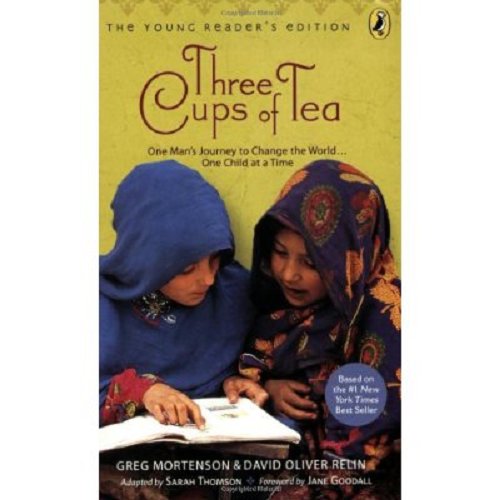
Three Cups of Tea is a great book for educational purposes, civil rights specifically. Three Cups of Tea is an autobiography by Greg Mortensen. Greg Mortensen tried to climb K2 [a Himalayan mountain],but he fails, and on the way down the mountain he wanders into Korphe, Pakistan. He is welcomed into the home of the village chief Haji Ali. Greg stays there for a while. When he leaves he sees they have no school. Greg promises to build a school. He raises money for the school. With the help of a billionaire who sponsors the trip, he goes back and builds the school. Jean Hoerni the man who sponsored the trip creates the Central Asia Institute. Greg's the director of the Central Asia Institute, he now builds many schools. He is still at work in other countries like Pakistan and Afghanistan. Greg is so committed to his job he will go without seeing his family for 2 months.
This book can help you understand how the Middle East works and why it's hard to have a school there with all of the dictatorship. For example, in Korphe, Haji Ali had to give up half his best goats to build the Korphe school. He wanted the school that much. In Pakistan goats are like money. He barely had enough to feed his tribe after that. The guy who did this to Haji Ali was another tribe leader. This shows how bad the dictatorship is there. You'll also get a view of how one American [Greg] uses education to help fight terrorism in Afghanistan.
I recommend this book to everyone, especially to people who don't understand the Middle East very well. It will help those people view the Middle East from their side, not just ours. This author tells his story brilliantly. He doesn't fail to summarize all 55 schools in one book. You wont be disappointed if you read this book. It's a real page turner.
Based on what I've told you, and your background knowledge about the Middle East, how can reading a book like this change your views about the Middle East? If you want, do your own research.
Payton B.
Political Cartoon Ponderings

Political cartoons are a fun way to get a new perspective on issues and current events. Artists creatively use metaphors of language to make readers have to think beyond the literal. It is a great visual activity to promote your thinking. Study the political cartoon. What do you think the man in the tie is talking about. Be sure to explain your thinking.
Friday, November 2, 2012
Holiday Outlook

Holiday Tablets
Experts have used Christmas spending as a great economic indicator that will let us know if the economy is turning around. The confidence in the public to spend money on higher priced items will tell us if the new year be easier on the middle and lower classes, decrease unemployment, and improve our economic outlook.
Do you think this political cartoon by Joe Heller of the Green Bay Press-Gazette supports the idea of economic growth? What message is the artist trying to make? Can you make any connections to this cartoon?
Wednesday, October 17, 2012
Students Prepare for Election 2012
 Middle school students many not be confident in their selection for President of the United States, if they know who is running at all. Their background knowledge consists of the information they have gained by the highly suggestive political ads telling us that each candidate is a crook and neither can be trusted.
Scholastic Magazine has a page on their site that does a nice job breaking down the candidates and the political process. You have to dig a little, but there is a lot of information about what each candidate is all about and the obstacles they have to overcome to become president.
Diffen is a fun website that compares anything you can think of. It does a nice job breaking down the two candidates into two columns and covers a variety of issues. Some of the content is over my head, but there is a lot of interesting information that may help in your decision when voting time comes.
Middle school students need to think about the fact that whoever wins on November 6 is probably going to make decisions that will affect them directly when they are older. One good example is college tuition. It may not possible in the future for everyone to go to college if everyone can't afford it.
Merrill Middle School students can go to my web site to cast there vote for president starting on November 1. Be sure to be an informed voter. Don't be swayed by the opinions of others, make your opinion count.
Subscribe to:
Posts (Atom)